A motorcycle’s electrical system can be daunting to even the most adept home mechanic. And yet, the more complex these systems become—and the more important to a motorcycle’s function—the more useful, even critical, it will be to know something about them. That’s where this book comes in with a user-friendly guide to understanding, diagnosing, and fixing the electrical systems and components that make a bike run . . . or falter.
Â
Veteran technician Tracy Martin explains the principles behind motorcycle electrical systems and how they work. He details the various tools, such as multimeters and test lights, that can be used to evaluate and troubleshoot any vehicle’s electrical problem. And in several hands-on projects, he takes readers on a guided tour of their vehicle’s electrical system, along the way giving clear, step-by-step instructions for diagnosing specific problems.
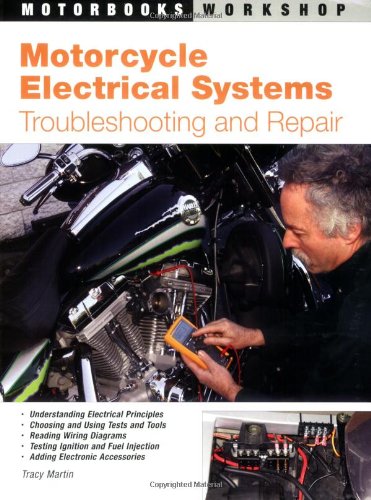
I’ve been working on cars and bikes for a long time, and am fairly knowledgeable. I thought I had a pretty good handle on automotive and motorcycle electrical systems.
I just found out how much I didn’t know.
Tracy Martin’s section on how resistance figures into the electrical picture was enlightening. Explaining exactly why the ohm-meter on your multimeter is mostly useless while working on a bike is great. His discussion of voltage drop testing gave me new testing routines, using just a simple meter.
He uses diagrams to help clarify his explanations. They are simple, but effective.
Yep – he likes high dollar tools (Fluke meters, for example) but he sounds less like an infomercial than many other DIY books.
I got the book as a Christmas gift, and had read about half of it. Today my truck failed to start (wouldn’t turn over). Using his techniques, I chased down the problem to a corroded terminal on the starter. I didn’t make a trip to the parts store, tow it to a mechanic, or start replacing things to see what might work.
This is good stuff.
I’m a motorcycle mechanic, a motorcycle enthusiast, and a degreed Mechanical Engineer. I collect and read books that deal with motorcycle maintenance, repair, improvement, and design. MOST of the books that I read are filled with popular misconceptions and misguided “shop knowledge” based on the “experience” of a poorly trained or poorly educated author. This particular book is well-researched, reasonably well-edited, well-formatted, and pretty easy to understand. It contains accurate technical information and is certainly capable of giving the reader a solid foundation in understanding and troubleshooting motorcycle electrical systems.
Excellent resource that covers the material specifically as claimed. Teaches in a conversational and enjoyable to read style. Takes someone who is not an electrical engineer through the necessary basics of electrical process specifically as it applies to motorcycle systems. Just enough theory for required understanding without extraneous complicated equations. It does cover with significant detail all material needed to allow the motorcycle owner to become fully versed with how electricity travels through the motorcycle. It clearly describes how to troubleshoot problems and then fix them. It includes lots of large, helpful diagrams and photos. After reading this book I have a profound confidence that the mystery of wiring diagrams and unseen electrical gremlins can be discovered, understood and fixed using this book and some inexpensive and readily available tools and materials. Great book by a talented author. I will look for other books he has written because I know I will likely enjoy those as well.
I bought Tracy Martin’s other book on automotive electrics, and as a motorcyclist, I was really excited when this book came out. It’s more of the same high quality of work. He’s got a real knack for explaining concepts in plain language I can understand easily. His illustrations are also very easy to follow. This book is great because there are lots of new material on motorcycle specific topics such as battery tenders, accessories, rebuilding starters, points ignition (where else can you find a current book that covers points???), and fuel injection.
Im very happy that i bought this book. I have to dispell the one reviewer whom was upset about the fact he went over his fluke multi meter.. I dont think it was a sales pitch at all. He was just explaining the product so you could follow along. YES this made me want to throw away my crappy multi meter.. If your new to this kinda home mechanic kinda stuff i would recommend this book!!!
I found the information given was easy to understand with explanations that made sense. No big words with jargon that only a rocket scientist could read. This is a welcome addition to understanding and fault finding electrics for all bikes (and cars / trucks etc). Very helpful on 30 year old Yamaha RZ500’s.
This book is great! I am building a motorcycle from the ground up with limited amount of off the shelf chopper parts, so I needed a book that could teach me the ins and outs of how a motorcycle electrical system works and this book delivers. I never did any electrical work on my motorcycle before but now i have the confidence to work it out. The author builds upon concepts through each chapter in a logical manner. Explains how to use a voltmeter and other testing tools. The price of this book could save you hundreds of dollars spent on parts when often it is a bad connection that is causing the problem. The author describes various ways to check systems and pin point problems. Get this book if you want to know motorcycle electrical systems.
The book is straightforward and easy-to-read. It covers various aspects of critical test instruments, electronic components, troubleshooting techniques, and shortcuts. It has a chapter with practice problems designed to improve the reader’s ability to use circuit diagrams. In particular, the sections on testing by voltage drop and using wiring diagrams are particularly useful.
The book is a bit marred by a few (not too many) mistakes and weak explanations. The author gets the relationship between dwell angle and point gap backwards, and at one point he describes a test method as “place the red lead here, and the red lead here”. He clearly meant one of the leads to be the ground (black) but it could prove confusing to the target audience. He gives short shrift to CD ignitions and magnetos. His states his coil testing procedures will work on all coils, without clarifying if that includes capacitive coils as well as inductive types (CD coils are a special case, as they do not have 12 volt primaries). His stator testing heuristic -wattage divided by four equals output AC voltage- is useful but given without information as to why the rule-of-thumb holds true.
These lapses are not indicative of a lack of knowledge on the author’s part, but point toward a need for a better review of the draft manuscript prior to publication.
Even with faults, I give the book a “B+”. It is worth reading, with the caveat that a reader may have to crosscheck a topic with another source if it just doesn’t seem right.
It goes without saying the best use of the book is to read and study it *before* the information is needed. Absorbing the knowledge during an emergency repair situation is difficult at best, impossible at worst.
I don’t do much with electrical stuff on my motorcycle, usually take it to the dealer. This book made made it easy to understand the electrical system on my bike. I like the chapter on wiring diagrams. This chapter really explained how to read the wiring diagrams. Good info on motorcycle batteries as well. I would recommend the book, even if you don’t plan on doing your own electrical repairs.
This manual does exacly as it says in simple clear terms. what more can you ask for.