Comprehensive volume of practical information, written by a talented automotive and aviation pioneer and published in the early 20th century, provides advice on everything from mufflers and automatic oil pumps to batteries and timing valves. Enhanced with more than 370 rare illustrations, the easy-to-read book will appeal to collectors, dealers, and riders.
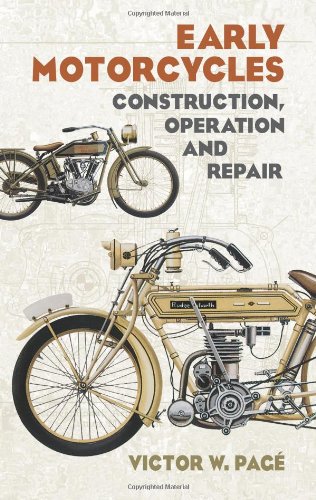
This is a modern reprint of a book published during the early days of motorcycles. The first edition was published in 1914, and the last in 1924. It covers mainly American motorcycles made from the pre-teens up to the early ’20s, but there is some reference to European ones. It shows how to repair, maintain, and operate those early bikes, and is probably the only book with that specialiy for that that time period. A fantastic reference, and every motorcycle history and restoration person should get it as a reference. Very highly recommended.
Early Motorcycles: Construction, Operation and Repair was first published in the 1920s, when thousands of motorcycles were already in use. Author Victor Page himself was an early transportation pioneer: his background lends to a lively survey of motorcycles, from engines, lubrication and materials to gear types and standard equipment. It’s hard to believe EARLY MOTORCYCLES first appeared in 1924 – and that the instructions on operation and repair remain as relevant today as it did when it was first published.
Pagé had an interest in automobiles, motorcycles, and tractors of the day, publishing books on these and other subjects. ‘Early Motorcyles’ was originally titled ‘Motorcycles and Side Cars’, and was published in 1914. Further editions appeared in 1917 and 1919; cyclecars were added in 1919. This book is a reprint of the 1917 edition. At 550 pages and 350 illustrations, ‘Early Motorcycles’ is THE book on motorcycling from the Pioneer era, and it makes delightful reading today. The early successes and dead-ends of design appear side-by-side, as all were in use at the time. Clear writing and drawing explain how everything works – suspension, cam timing, sidecars, gearboxes, clutches, etc. Excellent value. http://www.thevintagent.blogspot.com
This is a reprint of the 2nd edition from 1924. Contains a wealth of information and illustrations I haven’t found anywhere else. Excellent look into the history and evolution of the early bikes. Worth every penny!
I belong to a motorized bicycle club and the first motorcycles were nothing more than a bicycle with a motor.
In trying to make as close a copy as possible using lawn mower motors for power this book has proven invaluable.
When you get a copy, and I hope you do because you deserve one, you will be amazed at the amount of work the author put in to compiling the drawings and early photographs.
No component has been overlooked and the drawings are original and the book has them on almost every page.
Operating and repair instuctions are included as well.
If you are a fan of sidecars as I am, this book is for you.
Every motorcycle made in North America has been been included and many Foreign ones as well. Tricycles are included as well. If your interested in early motorcycles this is a must have book.
Thank you Mr. Page for your fine book and Thank you Amazon for selling it.
If you want to learn the technical aspects of the first twenty years of motorcycles this book will deepen your appreciation for the type, especially if you are lucky enough to own one or an enthusiast. It creates a snapshot when the earliest motorcycles were not even antiques yet! While many motorcycles from several manufacturers are identified and shown in scale drawings, it is not a history or identification guide, but a useful book for operating these now quite desirable antiques. It is not a narrative but a description of all the various mechanical aspects of the early breed, when the mechanic had to rely more on his senses than his instruments.