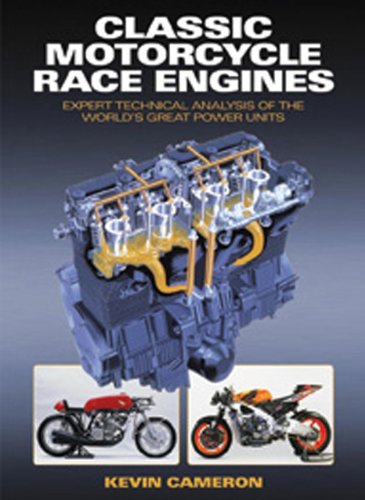
This authoritative book, elegantly written in highly digestible style by the foremost expert on the subject, provides in-depth analysis of classic motorcycle race engines spanning eight decades, from the 1930s Guzzi 500 120-degree twin to the latest Yamaha YZR M1 in-line four. Packed with technical detail, the book provides an absorbing insight into the technology employed in a wide variety of motorcycle engines, investigating the diverse approaches taken by various manufacturers over the years in the search for race-winning performance.
This is the third book that I’ve purchased written by Kevin Cameron. It exceeded my expectations with detailed descriptions and design tradeoffs for a lot of interesting engines. I especially liked the one non-motorcycle engine, the Cosworth Ford V8, which influenced so many later engines.
I am happy to add this book to my motorcycle book collection.
Kevin Cameron is THE best motorsports writer. His experience as a rider, mechanic and team owner combined with his technical competence give him a unique set of skills to explain to us the complexities of motorcycle performance. Besides that he’s a gifted writer.
Photos are not quite as good as I’d hoped. I build motorcycle models from scratch. These illustrations help, but not as much as could be.
Typical Kevin Cameron. One of if not the best at explaining technical things to the un-technical. Good or bad, it depends on how you read the book, there is a lot of redundancy of explanations of design elements. If you read the book from cover to cover it becomes bothersome to reread these explanations, although maybe good for retention. If you just pick out a particular marque you are interested in then there is a need to include this information.
This review does not cover the entire book as I just received it yesterday. However, after reading first few chapters and browsing of the rest of the book, it proves that Kevin’s writing remains at its best. Here his subject is the engines of racing motorcycles through history and he applies his usual style of examining the context, technological and engineering constraints and the social, economic and political scene in which these iconic and important powerplants were born. The book is substantial at over 400 pages. It isn’t a coffee table book, but a wonderfully dense blend of words and pictures – both color and black and white – by which he delivers his analyses. I’ve skimmed the book, looking over it’s design and subjects, and my sole complaint is that there aren’t more detailed engineering drawings, cut-aways and photos of the engines. Knowing Kevin, I’m certain his prose with allow me to mentally fill in the blanks beautifully. Thanks for another great read Kevin!
Hugely detailed and very well written. A must for detail freak petrol heads. Shows the steps taken during the development of some classic machinery and some of the politics and personalities that drove them. Fascinating.
Recommended read for anyone with a passion for racing engines! Lots of details and insights as to the development of many noteworthy motorcycle engines of the past and present.
Got into my favorite brand motors in the book (Ducatis and ye olde BritBike engines) and will eventually read all of the articles. Excellent writing. Good tech information for the tech junkies!
If you are a serious student of engines and engine design — whether such engines are to be found in cars, motorcycles, boats, go-karts, or the like — stop whatever you are doing and immediately buy and read Kevin Cameron’s new book “Classic Motorcycle Race Engines”, hot off Haynes Publishing’s (UK) press in November, 2012. To my knowledge, there has never been a book such as this, and you are not likely to see anything like it again. Kevin’s book is a herculean effort that is unique and immensely valuable to anyone in the automotive and motorcycle racing industry.
This is no book for reading dilettantes that can only handle a one page memo in one sitting. Kevin’s wisdom and experience are spread throughout 397 pages that thoroughly describe some 52 motorcycle race engines and one Formula 1 automotive engine from manufacturers around the world spanning the past 80 years of motorcycle (and auto) engine development.
Cameron writes with his usual clarity and elegance, with some occasional tweaks of humor as well. You can read his book straight through as I did, or you can skip around from chapter-to-chapter, focusing on either two-stroke or four-stroke engines, or engines from your favorite manufacturer(s) or country, or those engines from the pre-1950 era or the latest MotoGP engines circa 2010-2011.
Here’s what makes Cameron’s book so valuable and entertaining.
* Cameron covers the development of motorcycle racing engines from the 1920s through 2011. This includes obscure brands such as Aer Macchi, DKW, Konig, Mondial, Morini, MZ, and NSU, as well as Harley-Davidson and most of the British and Italian brands, and, of course, the big four Japanese brands.
* In the racing world, there are usually either four-stroke engine experts, or two-stroke engine experts. Kevin covers the development of both two and four stroke engines with equal passion and expertise. It is a rare treat to find such knowledge in one book.
* Not only does Cameron describe in great detail each engine’s development, but he adds tremendous value for the reader with his comments on racing engine engineering and technology. He covers in fine detail the development of the Cosworth Formula 1 DFV V8 racing engine — the first “modern” engine design in 1967 that pioneered (or “assembled”) so many new four-stroke engine design concepts. Kevin’s tremendous knowledge of engine design, not only in motorcycles, but in auto engines, diesel engines, and reciprocating aircraft engines gives him a rich basis for his insight into the 53 engines he chronicles in this book.
* Kevin’s engine histories are supported by solid engineering facts and principles — from the fields of thermodynamics, combustion chemistry, air flow, exhaust tuning, mechanical engineering — vibration, dynamics, lubrication, metallurgy, etc. If you have Cameron’s book, and Charles Fayette Taylor’s two books “The Internal-Combustion Engine in Theory and Practice: Volumes I and II” published by The MIT Press in 1966 and 1968 respectively, you will be way ahead in having a solid foundation of engine design principles.
* Cameron knows the theories of race engine design. But in addition, he has performed race engine testing and development work himself as a member of many professional motorcycle racing teams. He understands the values of simplicity, accessibility, low cost, and the minimization of parts as keys to a successful racing effort. He knows what it is like to work 7 X 24 during race week to get ready for a big event — to try to correct factory engineers’ mistakes and rectify manufacturing and suppliers’ quality problems, to keep engines intact, and to produce a motorcycle engine that will last long enough to not only finish but win the race.
* Cameron’s extensive contacts in racing and the motorcycle industry allow him to share the real stories behind the scenes that entertain his readers with rich “you are there” stories and insight.
Three big lessons stand out from reading Cameron’s fine book.
1. There are subtle differences in cylinder head and combustion chamber design that influence whether a race engine produces top-end horsepower or torque, but not both concurrently. You have to know what you want your engine to do well in a particular race event.
2. Most races on the average racing circuit are won in the corners, not on the straightaways. All other things being equal, manageable torque out of 10 to 20 corners usually beats a few miles per hour advantage at the end of one straight.
3. There is no end to the eternal quest for more manageable engine power, durability, simplicity, ease of maintenance, and low cost. Racing is a study in small incremental gains, 100 rpm at-a-time. Every year, small incremental improvements, often enabled by new technologies, keep things interesting and competitive in the motorcycle (or any racing) industry. You never get to rest on your laurels in racing.
Kudos to Cameron for an extraordinary book. It represents the best race engine knowledge-per-dollar book investment available. You will enjoy and treasure this book. I guarantee it.
If you like Top Dead Centre then you’ll enjoy this book. A walk through the development of Kevin’s choice of significant racing engines from the 30’s to the present day, the book covers each engine with a good mix of history, politics and personal stories about the men, their machines and the times they lived in. As someone who entered motorcycling in the Japo-centric early 80’s, I learnt and gained a much bigger appreciation for the significant European marques that dominated the 50 and 60’s before the coming of the dominant Japanese two-strokes. I would have liked more diagrams and some explanation of the terms used in glossary form, but otherwise this is a typically well-written, well-researched piece from one of my favourite columnists.