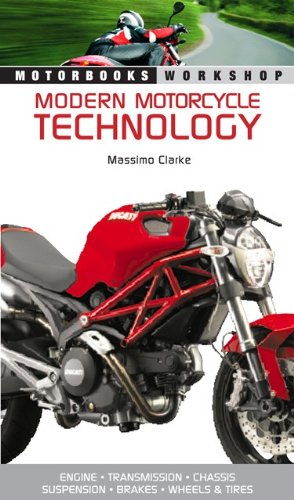
Modern Motorcycle Technology offers motorcyclists an up-to-the-minute technical overview and explanation for all the major mechanical and electrical systems comprising their motorcycle. Whether you ride a sport bike, cruiser, tourer, dual-sport, or off-road machine you’ll learn precisely how your bike works, which will help you keep your motorcycle in top condition.
Author Massimo Clarke takes you through all the major components of your motorcycle focusing on subjects such as engine architecture, fuel systems, transmission, and chassis. The detailed text is accompanied by revealing photos and diagrams that illuminate precisely how these systems work.
Whether new to motorcycling or a road-seasoned veteran rider, you’ll find page after page of fascinating information. Modern Motorcycle Technology is the single reference you’ll return to again and again.
Good read for someone looking for intro material on Motorcycles. I have some knowledge on bikes so this book was a little light on the technology side which is what I was looking for. Good intro for its intended target audience.
Very technical book with extremely poor graphics/illustrations. Very few graphics have colored illustrations or leader lines with a description to support the paragraphs. Similar to reading a map with out the topography….shortest distance from A to B is not always a straight line if you have to go over a mountain range (think Alps). Book describes specific parts of the engine and the adjacent graphic is an engine block or partial block (non-colored) and you are expected to focus on the specific spot…..unless you have taken apart an engine you will be lost in this book often as in every chapter. I do find the book helpful to better understand the mechanics of bikes but find it a struggle to read one time and understand without re-reading a Chapter or two over again. Many, many instances throughout the book where images and illustrations do not support the description or do so in a fashion that makes it difficult to the layman.
Not as good as I expected considering the other reviews I read. Some explanations aren’t very good. If you can, look at it before you buy.
I found this to be a generally nicely written, clear and concise book. It is, as another reviewer noted, more of a coffee table book than a technical manual. There are a lot of very decent illustrations that show more or less the same thing over and over again, allowing you to get a feel for the various different engineering solutions to specific engineering problems. The explanations are mostly understandable but it would have helped to have some arrows pointing directly to the illustration to let you know exactly which part the author is talking about (but this would have messed up the pretty pictures). Breadth and depth were appropriate for an introductory book, it’s enough to get you familiar with the terminology for looking things up later. There are lots of interesting details, and not many boring details. Overall I recommend it.
This book has given me a better understanding of sequential transmissions than any other I’ve read; however, most chapters left me wanting more information. While not a uniformly light treatment–many interesting technical details appear throughout the book–it would have to be a much larger, more comprehensive volume to provide the level of detail that I desire. This is closer to being a coffee table book than a service manual.
Pros: Great photos and diagrams; concise, clear descriptions
Cons: More general than specific
For 233 pages of contents, 169 pages were devoted to the engine.
The other components are just touched on very basically. I can get more from reading wikipedia. Paralever is talked about very briefly … No mention of Buell’s Zero Torsional Load brakes, etc. Its all about the engine. If you don’t know how an engine works, its a great book.
I can’t imagine how a book of this length, at this price, could cover a subject this complicated any better.
The subject matter is as technical and broad as anything in the realm of modern consumer products could be. There is almost no way to write such a book in a way that will satisfy all the interests of everyone from total neophyte to special-interest wonk. It will always be too simple for some and over the heads of others. However, this book seems to me to cover the great middle ground which will satisfy most who are interested in the title. It really does address the entire bike in detail, and is filled with wondrous diagrams and illustrations. To fully satisfy those who need text-tagged arrows pointing to every part or explanations of every nuance would require a much larger and more expensive work, probably a series of volumes for each area.
It is a very good book for the novice wanting an overview, and good reference for the more sophisticated.
Very informative and insightful book, well put together. Found it on a friend’s list through myList, which brought me here. A+ I use this book all the time.
If you want to learn about multi-weight oil I suggest reading Modern Automotive Technology by Duffy. The author of Modern Motorcycle Technology got it wrong. Where was the Tech proof reader before this went to print? I have a MS in Automotive Technology, ASE Master Tech, and taught MSF courses for 8 years. I also completed 2 years of advanced motorcycle mechanics at Johnson County Community College. I started riding motorcycle in 1963 so I know a thing or two about how engines work and how they are lubricated. Otherwise the book is OK.