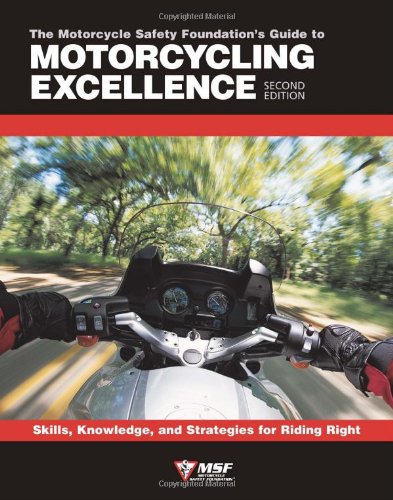
Here is a book for the motorcyclist who wants to do it right! The most complete, authoritative book ever published on safe riding techniques and strategies. More than one million students have completed courses developed by the Motorcycle Safety Foundation, and this book is the culmination of what that leading rider training organization has learned about teaching students of all ages and experience. It is the perfect refresher for anyone who has taken an MSF course and will be an eye-opener for those who have not yet discovered them. In a clear, engaging style with detailed diagrams and extensive full-color photographs and illustrations, the book covers rider attitude, proper dress, performance, maintenance and troubleshooting, as well as basic and advanced street skills. Included are tips on how to stop quickly when necessary; avoid traffic hazards; apply evasive maneuvers; countersteer for better control; travel skillfully in a group; identify and fix mechanical problems; ride more smoothly at high and low speeds; maintain momentum in off-highway riding; and much more. A remarkable source of riding wisdom, the first edition has been a best-seller and the definitive reference for the sport. This new second edition features the latest insights from the new, updated MSF curriculum, plus all new photos and graphics that make its valuable lessons easy to follow.
I have many of the how-to books for motorcycle riding. This is by far the best one.
As a novice motorcycle rider, I found this instruction manual to be very useful. I read it cover to cover before I even started riding, and there was a lot of good information in it I’m glad I knew before hitting the road. the chapter on traction dynamics is particularly helpful. Definitely worth reading.
Would rate it higher, but some of the writing seemed a little too sterile and official-sounding, and some of it is kind of dated. particularly the chapter on the effects of illegal drugs sounds like it was written in the 70s, so modern audiences might not relate to it well (though the bottom line that you should always ride sober is pretty clear). Also there are in fact better books on the subject. “Proficient Motorcycling” by David L. Hough covers almost everything in this, but at a higher level of detail and in a tone that is a little warmer and interesting to read. I’d choose that one if you had to pick, but I found it was still worthwhile to read both.
If you are one of the thousands of new (and older) bike riders out there, do yourself a BIG favor and read this book! It is hands-down the best on motorcycle safety. It describes, in detail, situations in which you’ll find yourself in city traffic or open roads where you will need to make split-second decisions to save your butt! I have ridden bikes for 40 years and I have learned things in this book that I hope will allow me to ride another 40! Buy it, read it, and follow the great tips on riding safely.
Very happy with this book. It covers all the information in the Motorcycle Safety Courses and then some.
Good to review after breaks in your riding so the informations is fresh when you go out again and keeps you conciences of safety when riding.
Let me start off by saying that this book does not bypass taking the MSF (Motorcycle Safety Foundation) riding class in anyway for a budding motorcycle rider. If you want to ride a motorcycle then the MSF course is a must period. The MSF class teaches you so much while allowing you to practice in a safe and calm riding environment with trained instructors at your side to ask questions and get help from. Not to mention that some insurance companies will give you a policy discount on your monthly insurance payments for taking and passing the MSF course. You also don’t have to do the DMV riding test if you pass the MSF course. So in the end the MSF course is more then worth what you paid to take the course for on top of the safety and riding training you get.
Outside of the MSF course this book is a good primer to mentally prepare you for the key ideas on how to ride a motorcycle and what forces are at work while riding. Ideas like counter steering, smooth control inputs, avoiding target fixation, and a light over view of potential road hazards you might face and many more other topics are all discussed in this book. It also goes on to talk about other areas some people might not think about such as how to select a proper helmet and what to look for in riding gear. It also talks about the effects of lack of sleep, drugs and alcohol all have on a rider. I would recommend this book to anyone who has signed up for the MSF course but has not taken it or who is just interested in the idea of riding a motorcycle. In the end this is a very good primer book if not a refresher for those who have just finished the MSF course and need to brush up a little on some key concepts.
I found this book to be an excellent source of safety info and real-world road strategies that may just save your life. Great pictures and diagrams. Read this before you take your MSF class and you’ll have a huge head start.
MOTORCYCLING EXCELLENCE is perhaps the best nuts-and-bolts primer on motorcycle riding yet published. It covers the subject thoroughly, a single source for knowledge and wisdom in the basics. It addresses attitude, basic skills, controls, gear, safety inspections, night and group riding, streetb strategies, off-road techniques . . . the gamut of essentials. Plus the basics of training, from the Motorcycle Safety Foundation, official authors of the book.
Most people, perhaps 90% of road users, consider motorcycles as ‘just other vehicles.’ They aren’t. Motorcycles are as different from four-and-more wheelers as swimming is from walking, as reading is from watching TV. Learning to operate a motorcycle safely and well is as difficult, but as challenging and rewarding as, say, learning to fly, scuba dive or climb mountains–and survive. Like those other unforgiving pursuits, do it right or risk serious consequences. Motorcycling is an honest trade: incompetence, inattention or bad luck can kill or maim in seconds. That’s where this book shines, in identifying and hammering home the essentials.
Expert contributors–a ‘who’s-who’ of experience: Nick Ienatsch on picking the right bike, World MotoGP champion on safety gear and bike control, Paul Thede on suspension, AMA 250 champion Rich Oliver on stopping, Erik Buell on bike geometry, Reg Pridmore on the need for smoothness, Keith Code on counter-steering, World MotoGP champion Freddie Spencer on trail braking.
Why read this book? Complex, high-risk activities demand study and practice at all experience levels. In an era in which school-student driver training has been discontinued and the road IQ of most car drivers is at flat-worm level, riders are at risk and must defend themselves. Every ride is a learning experience. This book will enhance the first, high-risk 50,000 miles in every rider’s life (thus it’s an ideal gift for offspring). And the next 250,000 miles for experienced riders.
The illustrations and photographs are lavish and excellent. The appendices–MSF training, proper bike inspection, and a glossary–are thorough and well done. There are omissions, though, whence the loss of a review ‘star:’ e.g. tire compromise between wear and stiction (which is not yet intuitive for many riders), the availability of waterproof linings such as Goretex for gear. The editing, too, lacks polish–too many passages are prolix and rambling instead of being tight and tough. The message gets through, anyway.
This book is excellent, and covers all you need to know as a first time motorcyclist. The one thing I cannot stress enough: Read it before you take the class (and be sure to take the MSF class, it will save your life!) The first section of the book is identical to the class in many ways, and, although I read through all of it again, it really is exactly the same. If you read this ahead of time, it will have you ready for the written test in the classroom, so that the class itself becomes review, and you can focus more on the hands-on part of the course while you are there, instead of trying to remember all of the new info in your head.
A casual remark about motorcycles from my wife sparked an ember of interest in both of us. Soon I was looking for more information on the Internet. Many website kept referring newbie riders to the Motorcycle Safety Foundation. I figured that their motorcycle primer would be a good place to start.
The book thoroughly covers the basics – parts of a motorcycle, controls, how to ride, and how to stay safe. Lots of illustrations and photographs make visualization easy and the text is written expressly for those of us with absolutely no experience on a bike.
Further chapters try to explain traction dynamics, countersteering, cornering, and street smarts. None of these chapters became too bogged down by the abstract concepts. Again, some nice illustrations did wonders toward explaining traction and center of gravity.
Excellent book! I have my bike permit and can’t wait to attend an MSF Safety Class and get my license!
This book is essentially the expanded version of the booklet they give you at the MSF Basic Rider’s Course. As such, I found nothing useful in it. It would be a great book to read before you take the class, though. I was looking for strategies on braking and cornering in various conditions, but what I got was just a listing of road conditions, not what to do about them. It mentions the different types of skids, but not how to recover from them. I guess they want us to have to take their Advanced class…